Unveiling The Mystery: Why Dyes Dance Or Stall In Chromatography
In chromatography, dyes are used to separate and identify different components of a mixture. Dyes are typically colored molecules that have an affinity for certain types of molecules. When a dye is applied to a chromatography column, it will bind to the molecules in the mixture that it has an affinity for. The different molecules in the mixture will travel through the column at different rates, depending on their size, shape, and charge. Dyes that have a strong affinity for the molecules in the mixture will travel slowly through the column, while dyes that have a weak affinity for the molecules in the mixture will travel quickly through the column.
There are a number of reasons why a dye might not move in chromatography. One reason is that the dye may not have any affinity for the molecules in the mixture. Another reason is that the dye may be too large to fit through the pores in the chromatography column. Finally, the dye may be charged, and the charge may prevent it from moving through the column.
If a dye does not move in chromatography, it can be difficult to identify the components of the mixture. In some cases, it may be possible to use a different dye that has a stronger affinity for the molecules in the mixture. In other cases, it may be necessary to use a different chromatography technique.
why would a dye not move in chromatography
Chromatography is a technique used to separate and identify different components of a mixture. Dyes are often used in chromatography because they are colored molecules that have an affinity for certain types of molecules. When a dye is applied to a chromatography column, it will bind to the molecules in the mixture that it has an affinity for. The different molecules in the mixture will travel through the column at different rates, depending on their size, shape, and charge. Dyes that have a strong affinity for the molecules in the mixture will travel slowly through the column, while dyes that have a weak affinity for the molecules in the mixture will travel quickly through the column.
- No affinity
- Too large
- Charged
- pH
- Temperature
- Solvent
- Column
- Flow rate
- Detection
- Interpretation
These are just a few of the key aspects that can affect the movement of a dye in chromatography. By understanding these factors, it is possible to optimize the chromatography process to achieve the desired results.
No affinity
In chromatography, the movement of a dye is dictated by its affinity for the molecules in the mixture and the stationary phase. If a dye has no affinity for the molecules in the mixture, it will not bind to them and will therefore not move through the column. This can be due to a number of factors, including the chemical structure of the dye and the pH of the mobile phase.
- Chemical structure
The chemical structure of a dye can affect its affinity for the molecules in the mixture. For example, a dye that is composed of a large, non-polar molecule will have less affinity for a polar mobile phase than a dye that is composed of a small, polar molecule.
- pH
The pH of the mobile phase can also affect the affinity of a dye for the molecules in the mixture. For example, a dye that is protonated at low pH will have less affinity for a negatively charged molecule than a dye that is deprotonated at high pH.
If a dye has no affinity for the molecules in the mixture, it can be difficult to identify the components of the mixture. In some cases, it may be possible to use a different dye that has a stronger affinity for the molecules in the mixture. In other cases, it may be necessary to use a different chromatography technique.
Too large
In chromatography, the size of a dye molecule can affect its movement through the column. If a dye molecule is too large, it may not be able to fit through the pores in the chromatography column. This can prevent the dye from moving through the column and can make it difficult to identify the components of the mixture.
The size of a dye molecule is typically measured in daltons (Da). The dalton is a unit of mass that is equal to the mass of one hydrogen atom. Dyes that are used in chromatography typically have a molecular weight of less than 1000 Da. However, some dyes can have a molecular weight of more than 1000 Da. These dyes are often referred to as macromolecules.
Macromolecules are often too large to fit through the pores in a chromatography column. This can prevent them from moving through the column and can make it difficult to identify the components of the mixture. In some cases, it may be possible to use a different chromatography technique to separate macromolecules. However, in other cases, it may not be possible to separate macromolecules using chromatography.
Charged
In chromatography, the charge of a dye molecule can affect its movement through the column. If a dye molecule is charged, it will be attracted to the oppositely charged electrode in the chromatography column. This can prevent the dye from moving through the column and can make it difficult to identify the components of the mixture.
The charge of a dye molecule is typically determined by the pH of the mobile phase. At low pH, most dyes are positively charged. At high pH, most dyes are negatively charged. However, some dyes can be zwitterionic, meaning that they have both positive and negative charges at the same time. Zwitterionic dyes are not affected by the pH of the mobile phase.
If a dye is charged, it is important to choose a mobile phase that has the opposite charge. This will help to prevent the dye from binding to the column and will allow it to move through the column more easily. In some cases, it may be necessary to use a buffer to adjust the pH of the mobile phase.
The charge of a dye molecule can be a useful tool for separating different components of a mixture. For example, ion exchange chromatography can be used to separate charged molecules based on their charge. This technique is often used to separate proteins and other biological molecules.
pH
In chromatography, the pH of the mobile phase can affect the movement of a dye through the column. The pH of a solution is a measure of its acidity or alkalinity. It is measured on a scale of 0 to 14, with 0 being the most acidic and 14 being the most alkaline.
- Effect on Dye Charge
The pH of the mobile phase can affect the charge of a dye molecule. At low pH, most dyes are positively charged. At high pH, most dyes are negatively charged. However, some dyes can be zwitterionic, meaning that they have both positive and negative charges at the same time. Zwitterionic dyes are not affected by the pH of the mobile phase.
- Effect on Dye Solubility
The pH of the mobile phase can also affect the solubility of a dye. Some dyes are more soluble in acidic solutions, while others are more soluble in alkaline solutions. If a dye is not soluble in the mobile phase, it will not be able to move through the column.
- Effect on Dye Binding
The pH of the mobile phase can also affect the binding of a dye to the stationary phase. Some dyes bind more strongly to the stationary phase at low pH, while others bind more strongly at high pH. If a dye binds too strongly to the stationary phase, it will not be able to move through the column.
It is important to choose a mobile phase with the appropriate pH for the dye being used. The pH of the mobile phase can be adjusted using a buffer.
Temperature
Temperature is an important factor that can affect the movement of a dye in chromatography. Temperature can affect the solubility of the dye, the viscosity of the mobile phase, and the binding of the dye to the stationary phase.
- Solubility
The solubility of a dye is the amount of dye that can be dissolved in a given amount of solvent. Temperature can affect the solubility of a dye in two ways. First, temperature can affect the solubility of the dye in the mobile phase. Second, temperature can affect the solubility of the dye in the stationary phase.
- Viscosity
The viscosity of a liquid is a measure of its resistance to flow. Temperature can affect the viscosity of a liquid in two ways. First, temperature can affect the viscosity of the mobile phase. Second, temperature can affect the viscosity of the stationary phase.
- Binding
The binding of a dye to the stationary phase is a key factor in determining how fast a dye will move through the column. Temperature can affect the binding of a dye to the stationary phase in two ways. First, temperature can affect the strength of the binding between the dye and the stationary phase. Second, temperature can affect the number of binding sites available on the stationary phase.
- Rate of movement
The rate of movement of a dye through a chromatography column is determined by a number of factors, including the solubility of the dye, the viscosity of the mobile phase, and the binding of the dye to the stationary phase. Temperature can affect all of these factors, and therefore it can have a significant impact on the rate of movement of a dye.
It is important to consider the effects of temperature when developing a chromatography method. By understanding how temperature affects the movement of a dye, it is possible to optimize the chromatography method to achieve the desired results.
Solvent
In chromatography, the solvent is the mobile phase that carries the sample through the column. The solvent plays a critical role in determining the movement of a dye through the column. There are a number of factors that can affect the interaction between the solvent and the dye, including the polarity of the solvent, the pH of the solvent, and the concentration of the solvent.
- Polarity
The polarity of the solvent is a measure of its ability to dissolve polar and non-polar compounds. Polar solvents are able to dissolve polar compounds, while non-polar solvents are able to dissolve non-polar compounds. The polarity of the solvent can affect the movement of a dye through the column in two ways. First, the polarity of the solvent can affect the solubility of the dye in the solvent. Second, the polarity of the solvent can affect the binding of the dye to the stationary phase.
- pH
The pH of the solvent can affect the movement of a dye through the column in two ways. First, the pH of the solvent can affect the charge of the dye. Second, the pH of the solvent can affect the binding of the dye to the stationary phase.
- Concentration
The concentration of the solvent can affect the movement of a dye through the column in two ways. First, the concentration of the solvent can affect the viscosity of the solvent. Second, the concentration of the solvent can affect the binding of the dye to the stationary phase.
It is important to choose a solvent that is compatible with the dye being used. The solvent should be able to dissolve the dye and should not bind to the dye too strongly. The solvent should also have the appropriate polarity and pH for the chromatography method being used.
Column
In chromatography, the column is a tube that is packed with a stationary phase. The stationary phase is a material that is coated with a thin layer of a solid material. The mobile phase is a liquid or gas that is passed through the column. The sample is injected into the mobile phase, and the components of the sample are separated as they pass through the column.
- Column efficiency
The efficiency of a column is a measure of its ability to separate the components of a sample. The efficiency of a column is determined by a number of factors, including the length of the column, the diameter of the column, and the particle size of the stationary phase.
- Column selectivity
The selectivity of a column is a measure of its ability to separate specific components of a sample. The selectivity of a column is determined by the chemical properties of the stationary phase.
- Column capacity
The capacity of a column is a measure of the amount of sample that can be separated on the column. The capacity of a column is determined by the size of the column and the particle size of the stationary phase.
- Column lifetime
The lifetime of a column is a measure of how long the column can be used before it needs to be replaced. The lifetime of a column is determined by a number of factors, including the type of sample being separated, the frequency of use, and the care that is taken of the column.
The choice of column is critical to the success of a chromatography separation. The column must be chosen based on the specific requirements of the separation. If the wrong column is chosen, the separation will not be successful.
Flow rate
In chromatography, the flow rate is the speed at which the mobile phase passes through the column. The flow rate can affect the movement of a dye through the column in two ways. First, the flow rate can affect the amount of time that the dye has to interact with the stationary phase. Second, the flow rate can affect the amount of time that the dye has to diffuse through the mobile phase.
- Retention time
The retention time is the time it takes for a dye to elute from the column. The retention time is affected by the flow rate. A higher flow rate will result in a shorter retention time, while a lower flow rate will result in a longer retention time.
- Peak shape
The peak shape is the shape of the peak that is produced when a dye elutes from the column. The peak shape is affected by the flow rate. A higher flow rate will result in a narrower peak, while a lower flow rate will result in a broader peak.
- Resolution
The resolution is the ability of a chromatography column to separate two different dyes. The resolution is affected by the flow rate. A higher flow rate will result in a lower resolution, while a lower flow rate will result in a higher resolution.
- Column efficiency
The column efficiency is a measure of the ability of a chromatography column to separate two different dyes. The column efficiency is affected by the flow rate. A higher flow rate will result in a lower column efficiency, while a lower flow rate will result in a higher column efficiency.
The flow rate is an important factor to consider when developing a chromatography method. The flow rate can affect the retention time, peak shape, resolution, and column efficiency of the separation. By understanding how the flow rate affects the movement of a dye through the column, it is possible to optimize the chromatography method to achieve the desired results.
Detection
In chromatography, detection is the process of measuring the amount of a substance in a sample. This information can be used to identify the components of the sample and to quantify their concentrations. There are a number of different detection methods that can be used in chromatography, including UV-Vis spectrophotometry, fluorescence spectroscopy, and mass spectrometry.
The choice of detection method depends on the specific application. For example, UV-Vis spectrophotometry is a good choice for detecting compounds that absorb light in the ultraviolet or visible region of the spectrum. Fluorescence spectroscopy is a good choice for detecting compounds that fluoresce. Mass spectrometry is a good choice for identifying and quantifying compounds in a complex sample.
The detection method can also affect the movement of a dye in chromatography. For example, if a dye is detected using UV-Vis spectrophotometry, the dye must be able to absorb light in the ultraviolet or visible region of the spectrum. If the dye does not absorb light in this region of the spectrum, it will not be detected and it will not move through the column.
Therefore, the detection method is an important factor to consider when developing a chromatography method. The detection method must be compatible with the dye being used and it must be able to provide the desired information about the sample.
Interpretation
Interpretation is an essential part of chromatography. It involves understanding the results of a chromatography separation and using this information to identify the components of a sample and to quantify their concentrations. In the context of "why would a dye not move in chromatography", interpretation plays a critical role in determining the cause of the problem and developing a solution.
- Identifying the problem
The first step in interpreting the results of a chromatography separation is to identify the problem. This involves understanding why the dye is not moving through the column. There are a number of possible causes, including:
- The dye is not soluble in the mobile phase.
- The dye is too large to fit through the pores in the stationary phase.
- The dye is charged and is interacting with the stationary phase.
- The flow rate is too high.
- The temperature is too high.
- The pH of the mobile phase is not correct.
- Developing a solution
Once the problem has been identified, the next step is to develop a solution. This may involve changing the mobile phase, the stationary phase, the flow rate, the temperature, or the pH of the mobile phase. It may also involve using a different detection method.
- Verifying the solution
Once a solution has been developed, it is important to verify that it works. This involves running the chromatography separation again and checking to see if the dye is now moving through the column. If the dye is still not moving, then the solution has not been successful and further troubleshooting is necessary.
Interpretation is an essential part of chromatography. It allows us to understand the results of a chromatography separation and to use this information to identify the components of a sample and to quantify their concentrations. In the context of "why would a dye not move in chromatography", interpretation plays a critical role in determining the cause of the problem and developing a solution.
FAQs about "why would a dye not move in chromatography"
Chromatography is a powerful technique for separating and analyzing complex mixtures. However, sometimes dyes do not move in chromatography, which can be frustrating for researchers. Here are answers to some frequently asked questions about this topic:
Question 1: Why might a dye not move in chromatography?
There are several reasons why a dye might not move in chromatography. One possibility is that the dye is not soluble in the mobile phase. Another possibility is that the dye is too large to fit through the pores in the stationary phase. Additionally, the dye may be charged and interacting with the stationary phase. Finally, the flow rate, temperature, or pH of the mobile phase may not be optimal.
Question 2: What can I do if a dye is not moving in chromatography?
There are several things you can do if a dye is not moving in chromatography. First, try changing the mobile phase. If the dye is not soluble in the current mobile phase, try using a different solvent. You may also want to try changing the pH of the mobile phase. If the dye is charged, you may need to use an ion-pairing agent to neutralize the charge.
Question 3: How can I optimize the conditions for chromatography?
There are several ways to optimize the conditions for chromatography. One important factor is the choice of stationary phase. The stationary phase should be able to interact with the dye in a way that allows for separation. The mobile phase should also be chosen carefully. The mobile phase should be able to dissolve the dye and elute it from the column. Finally, the flow rate, temperature, and pH of the mobile phase should be optimized.
Question 4: What are some common mistakes that can lead to dyes not moving in chromatography?
There are several common mistakes that can lead to dyes not moving in chromatography. One mistake is using a mobile phase that is not compatible with the dye. Another mistake is using a stationary phase that is not suitable for the dye. Additionally, the flow rate, temperature, or pH of the mobile phase may not be optimal.
Question 5: What are some tips for troubleshooting chromatography problems?
There are several tips for troubleshooting chromatography problems. First, try to identify the source of the problem. Is the dye not moving because it is not soluble in the mobile phase? Is the dye too large to fit through the pores in the stationary phase? Once you have identified the source of the problem, you can start to troubleshoot the issue.
Question 6: Where can I find more information about chromatography?
There are several resources available to learn more about chromatography. You can find books, articles, and online resources on this topic. Additionally, there are many chromatography courses and workshops available.
Summary:
Chromatography is a powerful technique for separating and analyzing complex mixtures. However, sometimes dyes do not move in chromatography. This can be due to a number of factors, including the solubility of the dye, the size of the dye, the charge of the dye, and the conditions of the chromatography experiment.
Transition to the next article section:
If you are having trouble getting a dye to move in chromatography, there are several things you can do to troubleshoot the problem. First, try to identify the source of the problem. Once you have identified the source of the problem, you can start to troubleshoot the issue. There are several resources available to help you learn more about chromatography and troubleshooting chromatography problems.
Tips to troubleshoot "why would a dye not move in chromatography"
Chromatography is a powerful technique used to separate and analyze complex mixtures. However, sometimes dyes do not move in chromatography, which can be frustrating for researchers. Here are five tips to help you troubleshoot this problem:
Tip 1: Check the solubility of the dye in the mobile phase
The dye must be soluble in the mobile phase in order to move through the column. If the dye is not soluble in the mobile phase, it will not be able to interact with the stationary phase and will not move through the column.
Tip 2: Check the size of the dye
The dye must be small enough to fit through the pores in the stationary phase. If the dye is too large, it will not be able to fit through the pores and will not move through the column.
Tip 3: Check the charge of the dye
The dye may be charged, which can affect its interaction with the stationary phase. If the dye is charged, it may be necessary to use an ion-pairing agent to neutralize the charge.
Tip 4: Optimize the flow rate, temperature, and pH of the mobile phase
The flow rate, temperature, and pH of the mobile phase can all affect the movement of the dye through the column. It is important to optimize these parameters to ensure that the dye moves through the column at the desired rate.
Tip 5: Use a different stationary phase or mobile phase
If the dye is not moving through the column, it may be necessary to use a different stationary phase or mobile phase. There are many different types of stationary phases and mobile phases available, so it is important to experiment to find the combination that works best for your particular application.
Summary:
If you are having trouble getting a dye to move in chromatography, there are several things you can do to troubleshoot the problem. First, check the solubility of the dye in the mobile phase, the size of the dye, and the charge of the dye. Next, optimize the flow rate, temperature, and pH of the mobile phase. Finally, try using a different stationary phase or mobile phase.
Conclusion:
By following these tips, you should be able to troubleshoot the problem of "why would a dye not move in chromatography" and get your dye moving through the column.
Conclusion
In this article, we have explored the question of "why would a dye not move in chromatography." We have discussed the various factors that can affect the movement of a dye in chromatography, including the solubility of the dye, the size of the dye, the charge of the dye, the flow rate, the temperature, the pH of the mobile phase, and the choice of stationary and mobile phases. We have also provided some tips for troubleshooting this problem.
Chromatography is a powerful technique for separating and analyzing complex mixtures. However, sometimes dyes do not move in chromatography. This can be due to a number of factors, including the aforementioned factors. By understanding the factors that can affect the movement of a dye in chromatography, it is possible to troubleshoot this problem and get the dye moving through the column.

Separating Mixtures — Overview & Common Methods Expii
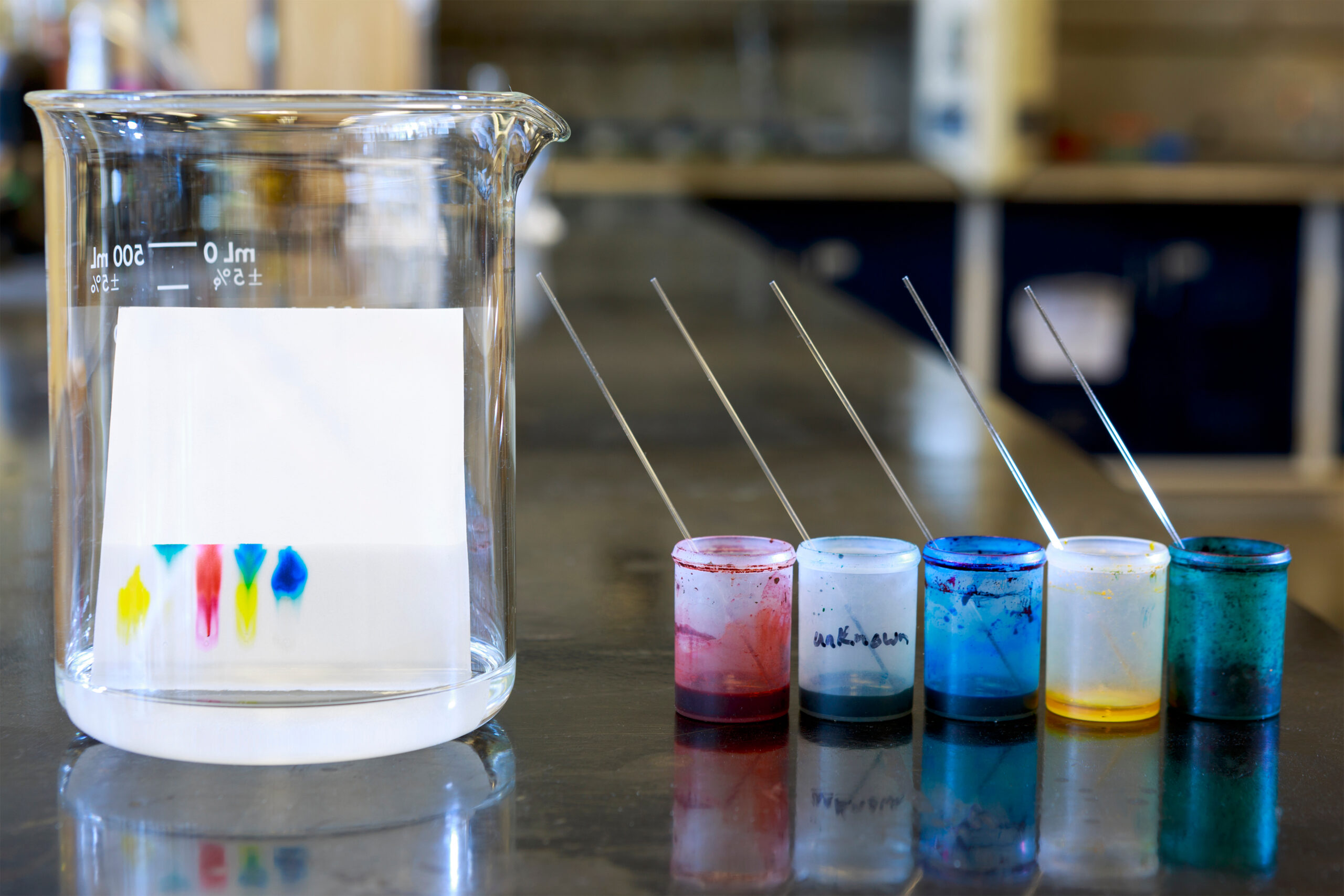
Chromatography Thin Layer Chromatography Mason Technology

Chromatography Invention of Chromatography Mikhail Tswett invented


